
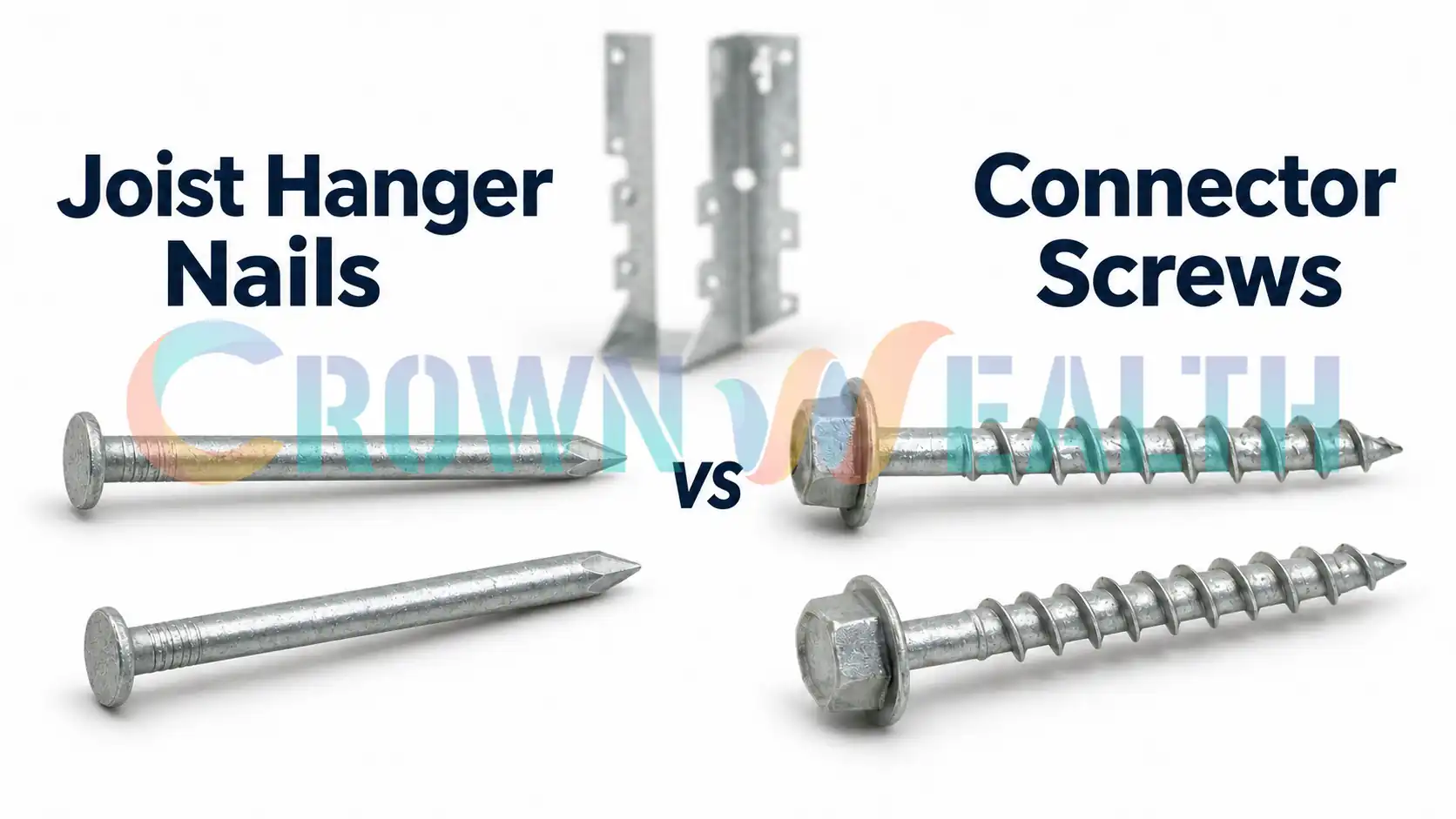
When installing joist hangers, should you use nails or screws? Choosing the right fasteners is just as important as choosing the right joist hanger.
Fastener type, size, quantity, and corrosion resistance all affect the strength and durability of the connection. This guide compares joist hanger nails and screws and explains how to select the right fasteners for your project.
Joist Hanger Nails vs. Screws: Key Differences
What Are Joist Hanger Nails?
Joist hanger nails are specialized fasteners used to secure metal joist hangers to wood framing members. They come in different diameters, lengths, and shank designs, including smooth-shank and ring-shank nails.
Ring-shank nails generally provide better withdrawal resistance than smooth-shank nails.
What Are Joist Hanger Screws?
Joist hanger screws are structural connector screws designed to fasten metal connectors to wood. Their threaded shanks provide good withdrawal resistance, while their head and shank designs help transfer loads.
These screws are designed and tested for load-bearing connections. Ordinary wood screws, drywall screws, and standard deck screws should not be used as substitutes.
Joist Hanger Nails vs. Screws
| Feature | Joist Hanger Nails | Structural Connector Screws |
| Withdrawal Resistance | Lower for smooth-shank nails; higher for ring-shank nails | Generally higher than smooth-shank nails |
| Installation Method | Hammer or connector nailer | Power driver |
| Installation Efficiency | Fast for repetitive installation with a connector nailer | Convenient for individual connections |
| Working Space | Requires hammer or nailer clearance | Convenient where hammer access is limited |
| Removal | Generally more difficult | Generally easier |
| Cost | Generally lower | Generally higher |
| Best For | Large-scale framing and budget-sensitive projects | Compatible connections in confined spaces |
Which Should You Choose?
✓ Choose Joist Hanger Nails
If you want to reduce fastener costs and install joist hangers efficiently on large framing projects, nails are often the better choice.
✓ Choose Joist Hanger Screws
If you have limited working space or need easier installation and removal, compatible structural connector screws may be more suitable.
How to Choose the Right Fasteners
Determine the Required Load
Before choosing nails or screws, determine how much load your joist hanger needs to support. This depends on the joist span, spacing, structural weight, and imposed loads.
The following table shows the minimum vertical load capacities for common joist sizes in residential wood decks.
| Joist Size | Minimum Vertical Capacity |
| 2 × 6 | 400 lbf |
| 2 × 8 | 500 lbf |
| 2 × 10 | 600 lbf |
| 2 × 12 | 700 lbf |
In addition to downward loads, consider uplift and lateral loads where applicable, particularly in roof structures.
NOTE
lbf stands for pound-force. 1 lbf ≈ 4.45 N.
Common Joist Hanger Nail and Screw Sizes
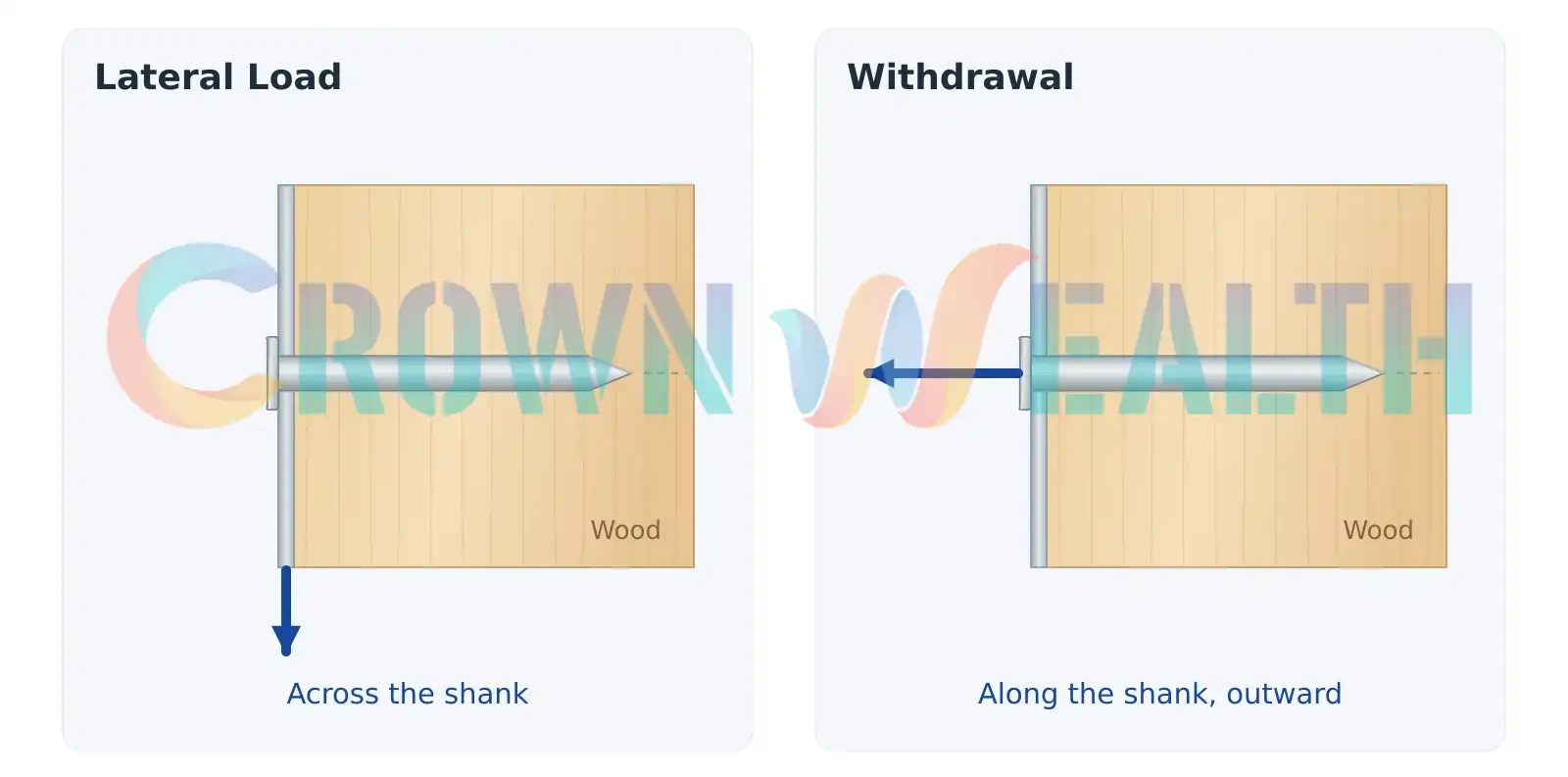
When choosing fasteners, consider their dimensions and two important performance characteristics:
01.
Lateral Resistance
Resists forces acting across the fastener shank as the hanger transfers loads to the supporting beam.
02.
Withdrawal Resistance
Helps prevent fasteners from pulling out of the wood when the hanger tends to rotate or pull away.
Nail Sizes and Reference Load Values
| Nail Type | Diameter × Length | Lateral (lbf) | Withdrawal (lbf/in.) |
| Connector Nail | 0.131″ × 1-1/2″ | 96 | 32 |
| Connector Nail | 0.148″ × 1-1/2″ | 113 | 36 |
| Connector Nail | 0.148″ × 2-1/2″ | 115 | 36 |
| Connector Nail | 0.162″ × 2-1/2″ | 138 | 40 |
| 8d Common Nail | 0.131″ × 2-1/2″ | 96 | 32 |
| 10d Common Nail | 0.148″ × 3″ | 115 | 36 |
| 16d Common Nail | 0.162″ × 3-1/2″ | 138 | 40 |
NOTE
- 8d, 10d, and 16d are traditional nail size designations known as penny sizes. For common nails, larger numbers generally indicate longer and thicker nails.
- Connector nails may be shorter. For example, a 10d common nail is 3″ long, while a 10d × 1-1/2″ connector nail is 1-1/2″ long.
Structural Connector Screw Sizes and Reference Load Values
| Screw Size | Unthreaded Shank Diameter | Lateral (lbf) | Withdrawal (lbf/in.) |
| #9 × 1-1/2″ | 0.132″ | 171 | 173 |
| #9 × 2-1/2″ | 0.132″ | 200 | 173 |
| #10 × 1-1/2″ | 0.161″ | 173 | 173 |
| #10 × 2-1/2″ | 0.161″ | 215 | 173 |
NOTE
- #9 and #10 indicate nominal screw diameter sizes. Within the same product series, a larger number generally indicates a thicker screw.
- #9 × 1-1/2″ means a No. 9 screw measuring 1-1/2 inches in length.
- lbf/in. means pounds-force per inch of applicable nail penetration or screw thread embedment in the wood.
Fastener Size, Quantity, and Placement
When selecting fasteners, consider the following four factors:
Match the fastener diameter to the hanger’s mounting holes and connection design. A fastener that is too thin may reduce connection strength, while one that is too thick may not fit properly.
Ensure sufficient penetration into the wood. Short fasteners may provide insufficient embedment, while excessively long fasteners may protrude through thin wood members.
Determine how many fasteners are required for each hanger, including those in the supporting beam and the joist.
Install fasteners in the required structural holes. Missing or incorrectly positioned fasteners can reduce connection strength.
For double-shear joist hangers, angled fasteners must be long enough to pass through the joist and penetrate the supporting beam.
Select Fasteners Based on Hanger Load Ratings
The same joist hanger can have different load ratings depending on the type, size, and quantity of fasteners used.
The following example shows how different fastening configurations affect the allowable downward load of a joist hanger.
| Fastener Type | Header Fasteners | Joist Fasteners | Allowable Downward Load |
| Nails | 6 × 0.162″ × 3-1/2″ | 4 × 0.148″ × 1-1/2″ | 845 lbf |
| #9 SD Screws | 6 × #9 × 1-1/2″ | 4 × #9 × 1-1/2″ | 1,025 lbf |
| #10 SD Screws | 6 × #10 × 1-1/2″ | 4 × #10 × 1-1/2″ | 1,040 lbf |
If your joist connection requires a downward load capacity of:
- 800 lbf: All three configurations meet the stated requirement. Nails may be the more economical choice.
- 900 lbf: The nail configuration is insufficient, while both screw configurations meet the stated requirement.
When choosing fasteners for Hbcrownwealth joist hangers, use the same selection method to compare your project’s load requirements with the verified load ratings of compatible fastening configurations.
Fastener Materials and Corrosion Resistance
Corrosion can weaken nails and screws over time, reducing the strength and service life of joist hanger connections. Therefore, you should choose fasteners that suit both the installation environment and the hanger material.
Fastener Materials and Coatings
Different fastener materials and coatings vary in corrosion resistance, suitable applications, and cost.
| Material / Finish | Corrosion Resistance | Best For | Cost |
| Zinc-Plated Steel | Basic | Dry indoor framing | Low |
| Hot-Dip Galvanized Steel | Moderate to high | Outdoor framing and compatible pressure-treated wood | Medium |
| Stainless Steel | High to very high | High-moisture and coastal environments | High |
NOTE
Actual corrosion resistance depends on coating thickness, stainless steel grade, and environmental exposure. Some structural connector screws also use mechanical galvanizing or other corrosion-resistant coatings.
Matching Fasteners to Joist Hanger Materials
Choose fasteners with materials and corrosion protection compatible with your joist hangers.
| Joist Hanger Material / Finish | Suitable Fasteners |
| Galvanized Steel | Compatible galvanized nails or coated connector screws |
| Hot-Dip Galvanized Steel | Hot-dip galvanized nails or connector screws with suitable corrosion protection |
| Stainless Steel | Stainless steel connector nails or screws of a suitable grade |
Some chemicals in pressure-treated wood can accelerate metal corrosion, so choose fasteners suitable for the specific wood treatment.
Avoid using galvanized fasteners with stainless steel joist hangers, as contact between these metals in moist environments can accelerate galvanic corrosion.
NOTE
For coastal and salt-exposed environments, consider 316 stainless steel joist hangers with matching 316 stainless steel fasteners.
Frequently Asked Questions
Can You Use a Nail Gun for Joist Hangers?
Yes. You can use a compatible metal connector nailer designed to locate and drive nails into connector holes. Avoid ordinary framing nailers that cannot accurately position the required nails.
Can You Mix Nails and Screws in the Same Joist Hanger?
Only when the specific mixed-fastener configuration has been verified for that hanger. Otherwise, mixing nails and screws may change the connection’s load capacity.
Can You Replace Existing Joist Hanger Nails with Screws?
Yes, if the hanger has a verified screw configuration suitable for the connection. Before replacing existing nails, ensure the connection is safely supported and check the condition of the wood and hanger.
OEM & CUSTOM MANUFACTURING
Hbcrownwealth specializes in manufacturing and supplying metal connectors, including joist hangers. We focus on material selection, precision stamping, and strict quality control to ensure consistent product quality and reliable performance.
With a wide range of joist hanger products, we can recommend suitable solutions based on your project requirements, joist dimensions, application, and installation conditions. Our team is also available to provide professional product guidance and technical support.
Explore Joist Hangers