
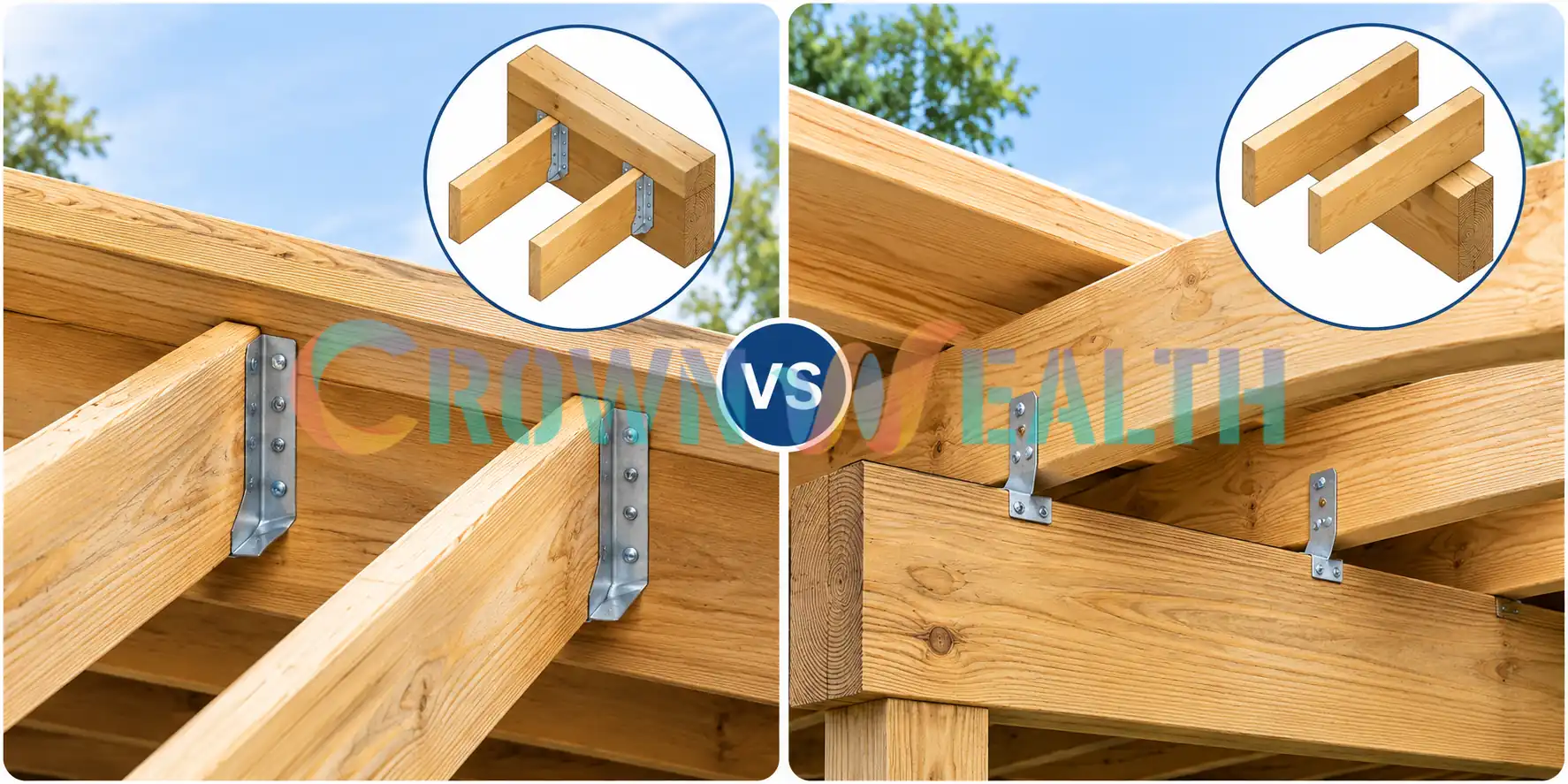
In deck and wood-framed floor construction, joists need proper support to transfer loads to the supporting structure. When connecting joists to a beam, two common methods are using joist hangers to support the joists from the side of the beam or allowing them to rest directly on top of the beam.
Both methods can provide reliable support when properly installed. However, they differ in load transfer, installation requirements, and suitable applications.
Two Ways to Connect a Joist to a Beam
Joist Hangers
Joist Hangers are steel connectors that support joist ends from the side of a beam, ledger board, or header. They transfer the joist loads to the supporting structure through the hanger and its specified fasteners.
This method is commonly used in flush beam framing, where the tops of the joists and beam are at the same level.
Resting on Beam
Resting on a Beam means placing joists directly on top of a drop beam, which sits below the joists. Vertical loads transfer through the contact surface between the joists and the beam.
This method is generally simpler to install, but the joists still need proper fastening and restraint to prevent unwanted movement or rotation.
| Beam Type | Beam Position | Typical Connection |
| Flush Beam | Top of the beam is level with the tops of the joists | Joist hangers support the joist ends |
| Drop Beam | Beam sits below the joists | Joists rest directly on the beam and are secured with appropriate fasteners or connectors |
Understanding Bearing and Restraint in Joist Connections
When joists rest directly on a beam, vertical loads transfer through the contact surface into the beam. However, bearing is not the same as restraint. Even with adequate support, joists can still move sideways, lift, or rotate.
To keep the connection stable, you need suitable fasteners, mechanical connectors, or blocking. These measures help control movement and rotation, while properly rated connectors provide uplift resistance where required.
With joist hangers, vertical loads transfer through the steel hanger seat and specified fasteners into the supporting beam or other structural member.
Joist hangers can also provide some resistance to rotation, and certain models offer rated uplift resistance. Their performance depends on the hanger design, load ratings, and proper installation.
Joist Hangers vs Resting on Beam
Both joist hangers and beam-top bearing can provide reliable structural support when designed and installed correctly. However, they differ in load transfer, connection stability, material costs, installation, and long-term maintenance.
| Comparison | Joist Hangers | Resting on Beam |
| Vertical Load Transfer | Loads transfer through the steel hanger seat and specified fasteners into the supporting member | Loads transfer directly through the contact surface between the joist and beam |
| Uplift Resistance | Certain models provide rated uplift resistance, depending on their design and installation | May require mechanical connectors or hurricane ties to resist uplift loads |
| Lateral Restraint | Hangers and fasteners provide some restraint; additional bracing may be necessary | Mechanical connectors, approved toenailing, or blocking help control movement and rotation |
| Material Cost | Generally higher due to the additional hangers and specified fasteners | Usually lower because hangers are not needed, although fasteners and restraints still add costs |
| Installation Skills | Requires correct hanger selection, positioning, and installation of specified fasteners in the required holes | Generally simpler, but accurate cutting, adequate bearing length, proper contact, and secure fastening are essential |
| Adjustability | Repositioning an installed hanger usually requires removing and reinstalling the connector | Joists are easier to reposition before fastening; adjustments after installation also require removing connections |
| Compatibility with Pressure-Treated Wood | Galvanized or stainless steel connectors must be compatible with the wood treatment and fasteners | Also suitable for treated wood, but contact surfaces need proper drainage, moisture protection, and corrosion-resistant fasteners |
| Maintenance | Check for corrosion, bent hanger flanges, missing or loose fasteners, and gaps between the joist and hanger seat | Check for joist movement, wood splitting, end deterioration, damaged bearing surfaces, and failed restraints |
| Common Installation Problems | Incorrect hanger size or load rating, improper fasteners, missing required fasteners, or poorly seated joists | Insufficient bearing length, poor contact, joist movement or rotation, improper fastening, or missing restraints |
How to Choose the Right Joist Connection
Choosing between joist hangers and resting joists on a beam depends on your framing layout, load requirements, installation costs, and environmental conditions.
- Framing Layout: If the beam sits below the joists and provides adequate bearing, resting the joists on top is often simpler and more economical. For flush beam framing, joist hangers are usually the preferred solution.
- Load and Stability: Both methods must safely transfer loads and prevent unwanted movement, uplift, or rotation. For joist hangers, check the rated load capacity and specified fastener requirements.
- Installation and Cost: Resting joists on a beam can reduce hanger costs, while joist hangers are well suited to side-mounted connections and framing where overall depth is limited. Total costs also depend on labor, materials, and additional restraints.
- Environmental Conditions: For outdoor decks or pressure-treated lumber, choose corrosion-resistant connectors and fasteners that are compatible with the wood treatment and exposure conditions.
OEM & CUSTOM MANUFACTURING
Hbcrownwealth specializes in manufacturing and supplying metal connectors, including joist hangers. We focus on material selection, precision stamping, and strict quality control to ensure consistent product quality and reliable performance.
With a wide range of joist hanger products, we can recommend suitable solutions based on your project requirements, joist dimensions, application, and installation conditions. Our team is also available to provide professional product guidance and technical support.
Explore Joist Hangers