
Choosing the right joist hanger size helps ensure proper support, reliable load transfer, and connection stability. Whether you are building a deck, floor, or roof, you need to match the hanger dimensions to your joist and supporting structure.
This guide explains the key factors to consider when selecting joist hanger sizes.
Nominal vs. Actual Lumber Dimensions
Nominal size is the traditional size used to identify and sell lumber. Actual size refers to the physical dimensions of the lumber after processing.
During production, wood shrinks as it dries, and planing removes surface material to create a smooth and uniform finish. As a result, standard dressed lumber is smaller than its nominal size.
For example, a standard North American 2 × 8 joist typically measures 1-1/2 × 7-1/4 inches.
Common Lumber Size Chart
| Nominal Size | Actual Size (inch) | Actual Size (mm) |
| 2 × 4 | 1-1/2 × 3-1/2 | 38 × 89 |
| 2 × 6 | 1-1/2 × 5-1/2 | 38 × 140 |
| 2 × 8 | 1-1/2 × 7-1/4 | 38 × 184 |
| 2 × 10 | 1-1/2 × 9-1/4 | 38 × 235 |
| 2 × 12 | 1-1/2 × 11-1/4 | 38 × 286 |
These are common dimensions for dry, surfaced North American softwood lumber. Dimensions may vary depending on regional standards, moisture content, and processing methods.
Always check the actual dimensions of your joist before choosing a hanger.
Joist Width and Hanger Width
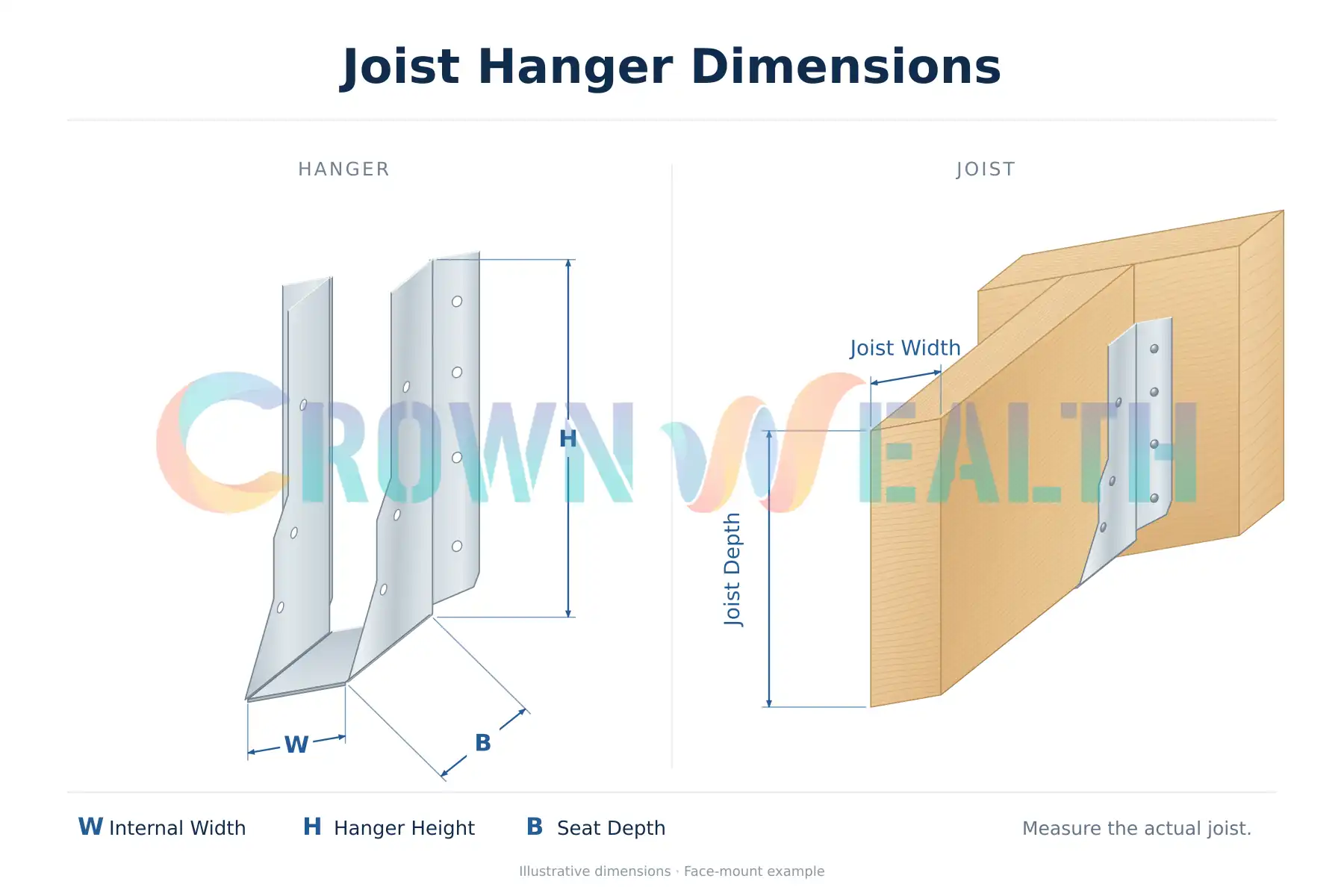
The actual width of your joist determines the required internal width of the hanger. The hanger should fit closely around the joist without excessive gaps or forcing the wood into place.
If you are using double or multi-ply joists, measure the combined width of all members.
| Joist Configuration | Typical Actual Width |
| Single 2× joist | 1-1/2″ (38 mm) |
| Double 2× joist | 3″ (76 mm) |
| Triple 2× joist | 4-1/2″ (114 mm) |
For engineered wood products such as LVL and I-joists, check their actual dimensions and select a hanger designed for the specific wood profile.
Joist Depth and Hanger Height
Joist depth is the vertical distance from the top to the bottom of the joist. It helps determine the appropriate hanger height.
A joist hanger does not necessarily need to cover the full depth of the joist. However, its height and design must provide adequate support and rotational restraint.
Hanger Seat Depth
Seat depth refers to the front-to-back length of the hanger’s bottom support plate.
The joist must rest fully on the hanger seat to provide the intended bearing support. You should also check that the gap between the joist end and the supporting member stays within the manufacturer’s permitted limits.
Excessive gaps can reduce the load capacity of the connection.
Connection Angle
Different connection angles require different joist hanger designs. Check whether your joist connects at a right angle, a horizontal angle, a vertical slope, or a combination of both.
| Connection Angle | Suitable Joist Hanger |
| Standard 90° connection | Standard joist hanger |
| Horizontal angled connection | Skewed joist hanger |
| Vertical sloped connection | Sloped joist hanger |
| Combined horizontal angle and vertical slope | Skewed and sloped joist hanger |
For angled connections, confirm both the angle and direction before purchasing.
Do not bend or modify a standard joist hanger unless the manufacturer allows it.
Supporting-Member Dimensions
In addition to the joist dimensions, you need to check the size of the supporting beam, ledger board, or header.
- Thickness: Ensure sufficient material for the specified fasteners.
- Depth: Provide enough vertical space for the hanger and its fastening points.
- Mounting Space: Ensure sufficient space for the mounting flanges and required fastener spacing.
- Top Bearing Surface: Provide adequate support for top-flange joist hangers.
A hanger that fits your joist may not necessarily fit your supporting member.
Joist Hanger Size Selection Example
Suppose you need to select a joist hanger for a standard 2 × 8 wood joist.
| Selection Factor | Requirement |
| Nominal joist size | 2 × 8 |
| Actual joist width | 1-1/2″ (38 mm) |
| Actual joist depth | 7-1/4″ (184 mm) |
| Joist configuration | Single joist |
| Connection angle | 90° |
Start by selecting a hanger designed for a single 2 × 8 joist. Check its internal width, height, seat depth, and mounting dimensions against the manufacturer’s specifications.
If you use a double 2 × 8 joist, select a hanger designed for the combined width of approximately 3 inches (76 mm).
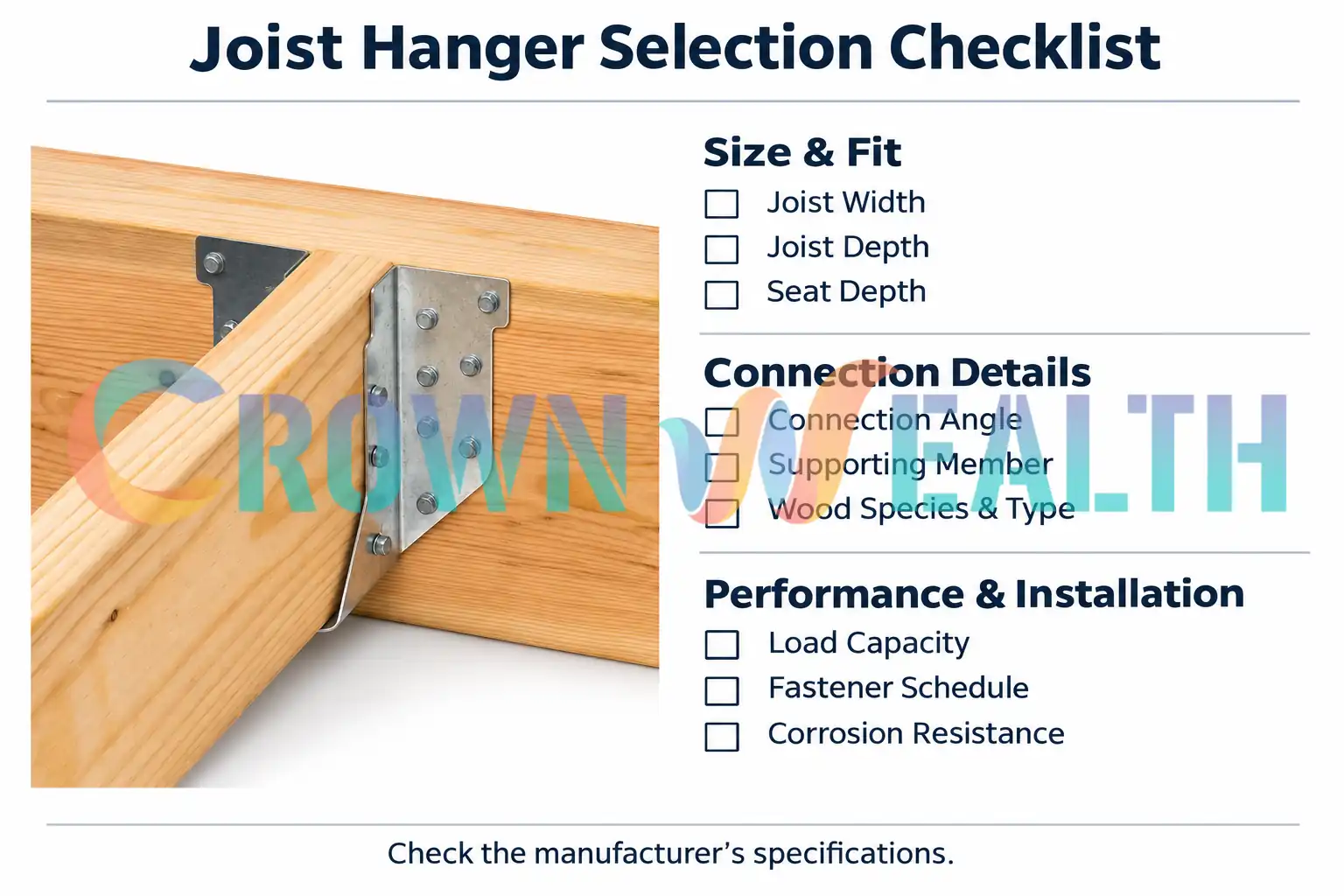
Joist Hanger Selection Checklist
Before buying joist hangers, check the following requirements:
| Selection Factor | What to Check |
| Joist width | Internal hanger width |
| Joist depth | Hanger height |
| Seat depth | Bearing support |
| Connection angle | Hanger shape and orientation |
| Supporting-member dimensions | Available mounting space |
| Load capacity | Downward and uplift requirements, where applicable |
| Wood species and type | Compatibility and applicable load ratings |
| Fasteners | Specified type, size, and quantity |
| Corrosion resistance | Wood treatment and installation environment |
Conclusion
To choose the right joist hanger size, start by measuring the actual dimensions of your joist and supporting member. Then match these measurements to the hanger width, height, seat depth, and connection angle.
Before purchasing, confirm that the selected hanger meets your load capacity, fastening, corrosion resistance, and applicable building code requirements.
OEM & CUSTOM MANUFACTURING
Hbcrownwealth specializes in manufacturing and supplying metal connectors, including joist hangers. We focus on material selection, precision stamping, and strict quality control to ensure consistent product quality and reliable performance.
With a wide range of joist hanger products, we can recommend suitable solutions based on your project requirements, joist dimensions, application, and installation conditions. Our team is also available to provide professional product guidance and technical support.
Explore Joist Hangers